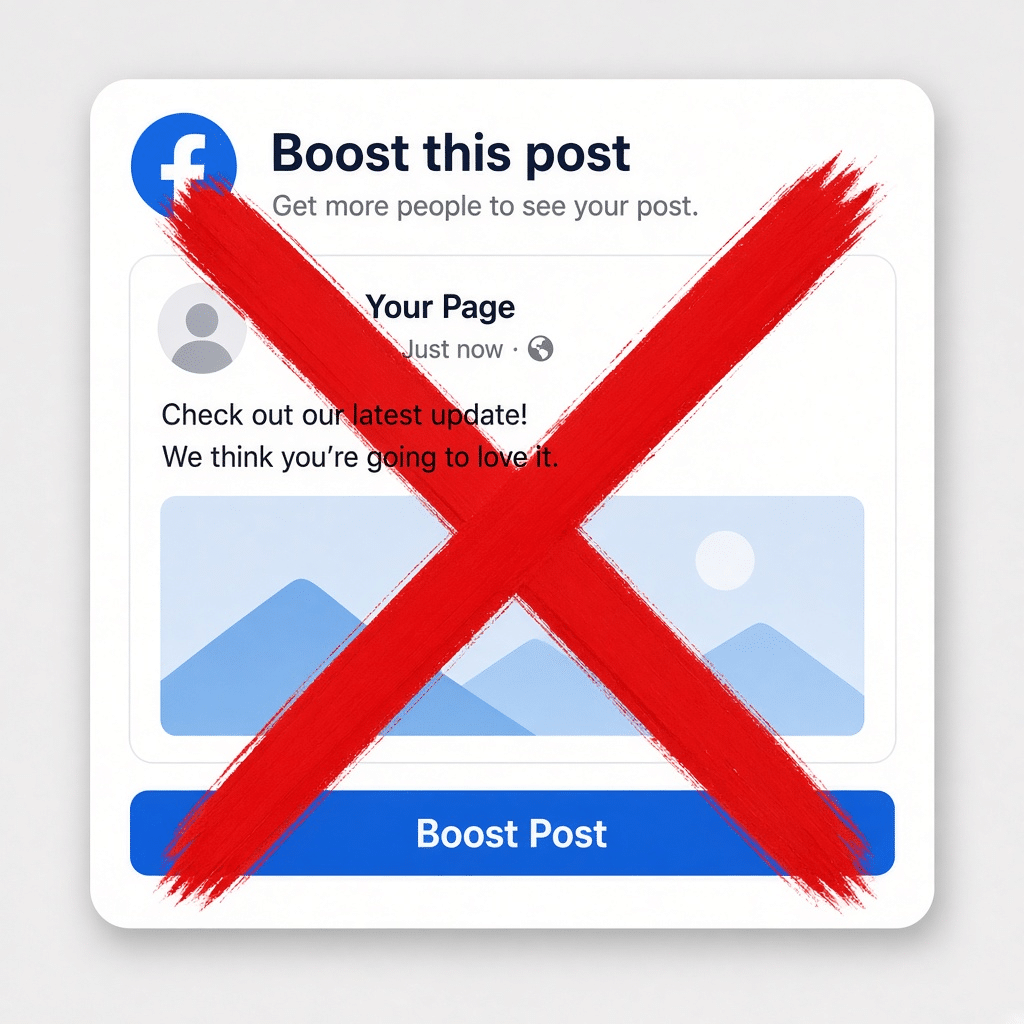
If your business has a Facebook or Instagram page, you have probably seen the familiar button encouraging you to “Boost Post.” It looks easy: choose a budget, select an audience, and suddenly your post is an advertisement.
Boosting a post can increase visibility, but visibility alone isn’t necessarily a marketing strategy.
Businesses that want social media to generate awareness, website traffic, leads, sales, phone calls, or other measurable results need to think beyond individual boosted posts. A structured paid social media strategy gives you greater control over who sees your advertising, what happens after they see it, and how your advertising dollars are being spent.
At Ad House Advertising, we believe social media advertising should be treated as part of your overall marketing strategy—not simply an occasional boost when a post isn’t getting enough engagement.
What Does Boosting a Post Actually Do?
A boosted post takes content you’ve already published and pays to distribute it to a larger audience. It can be useful when you want more people to see a particular announcement, event, promotion, video, or piece of content.
The problem isn’t necessarily the boost itself. The problem is relying on boosting as your entire social media advertising strategy.
When businesses repeatedly boost posts without an overarching plan, campaigns can become disconnected. One week you may promote an event. The next week you boost a product. Then you boost a company announcement. Money is being spent, but there may be no clear customer journey connecting those efforts.
A paid social strategy starts with a different question:
What are we trying to accomplish?
Start With a Marketing Objective
Before spending money on social advertising, businesses should identify what success looks like.
Are you trying to increase brand awareness? Drive people to your website? Generate leads? Promote a limited-time offer? Increase store traffic? Reach potential customers in a particular geographic area?
Different objectives require different campaigns.
For example, a local home service company looking for new customers may need a campaign focused on generating calls or leads. A homebuilder may want to promote available communities to people considering a move. A retailer could use social advertising to promote products and drive website or store traffic.
The creative, targeting, budget, landing page, and measurement strategy should all support the campaign’s primary goal.
Better Audience Targeting
One of the biggest advantages of a structured paid social campaign is the ability to think strategically about your audience.
Instead of simply trying to reach “more people,” advertisers can build campaigns around geography, demographics, interests, behaviors, previous website visitors, customer lists, and other available audience signals.
For New Mexico businesses, geography can be especially important.
A business serving Albuquerque and Rio Rancho may need a very different strategy from one trying to reach customers throughout New Mexico. A Santa Fe business may have different audiences than a company targeting Las Cruces, Taos, or the entire state.
Spending money to reach people who cannot realistically become customers doesn’t help your bottom line.
Don’t Show Everyone the Same Ad
A good paid social strategy also recognizes that not every potential customer is at the same point in the buying process.
Someone seeing your business for the first time may need an introduction to your brand. Someone who has already visited your website may be ready for a more specific message. An existing customer could respond to an entirely different offer.
That creates opportunities for different creative and messaging throughout the customer journey.
Instead of running one advertisement indefinitely, businesses can test different images, videos, headlines, calls to action, offers, and audiences.
Over time, campaign data can help identify which combinations are generating the strongest response.
Retarget People Who Already Know Your Business
Imagine someone clicks your social media advertisement, visits your website, looks at a service or product, and then leaves without contacting you.
That doesn’t necessarily mean they aren’t interested.
They may have been researching options, comparing prices, checking reviews, talking with a spouse, or simply gotten distracted.
Retargeting gives businesses an opportunity to reconnect with people who have already interacted with their brand.
A follow-up advertisement can remind them about your company, highlight another benefit, promote an offer, or encourage them to return to your website.
That is much more strategic than simply boosting another post and hoping the same person happens to see it.
Creative Matters Just as Much as Targeting
You can build an excellent audience and still have an unsuccessful campaign if the advertising doesn’t capture attention.
Your advertising is competing against friends, family, influencers, news, entertainment, other businesses, and countless other pieces of content.
Strong photography, graphic design, video, copywriting, and calls to action can make a significant difference.
Video is particularly valuable because one production can potentially create multiple pieces of advertising content. A longer video can be edited into shorter clips for Facebook, Instagram, YouTube, Connected TV, websites, and other digital channels.
Instead of thinking about social advertising separately, businesses can build creative that works across an entire media strategy.
Social Media Shouldn’t Exist in a Vacuum
Paid social advertising can be powerful, but it becomes even more effective when it works alongside your other marketing.
A potential customer might first see your commercial while streaming television. Later, they see a social media advertisement. A few days later, they search for your business on Google. Then they visit your website before finally calling.
Which advertisement deserves credit for that customer?
The answer may be all of them.
Modern consumers move between devices, platforms, websites, streaming services, search engines, and social networks throughout the day. That’s why Ad House Advertising approaches marketing from a broader perspective.
Paid social can work alongside Google Search, programmatic display, Connected TV (CTV), streaming video, traditional television, radio, outdoor advertising, SEO, website development, and other marketing channels.
The goal isn’t simply to generate more impressions. It’s to create multiple opportunities for the right customers to encounter your business.
Measure More Than Likes
Likes, comments, shares, and followers can provide useful information, but they shouldn’t automatically be treated as the ultimate measure of advertising success.
Businesses should look at metrics connected to their actual goals.
Depending on the campaign, that could include website visits, phone calls, form submissions, leads, conversions, video views, cost per lead, cost per click, or other meaningful actions.
Reporting also helps advertisers determine what isn’t working.
Campaigns shouldn’t simply be launched and forgotten. Performance should be reviewed, audiences refined, creative tested, and budgets adjusted based on what the data is showing.
Build a Strategy Instead of Hitting Boost
There is nothing inherently wrong with boosting a Facebook or Instagram post. Sometimes it’s exactly what a business needs to give an important piece of content additional exposure.
But boosting shouldn’t replace strategy.
If you’re investing money into social media advertising, you should know what you’re trying to accomplish, who you’re trying to reach, what message you’re delivering, and how you’re going to measure success.
At Ad House Advertising, we help businesses develop paid social campaigns that fit into a larger marketing strategy. From audience targeting and media planning to graphic design, video production, campaign management, and reporting, we help businesses turn social media advertising into a more strategic investment.
Instead of asking, “How much should we spend boosting this post?”
Start asking, “What do we want our advertising to accomplish?”
That’s where a real social media strategy begins.
Frequently Asked Questions
1. What is the difference between boosting a post and running a paid social media campaign?
Boosting a post pays to show an existing Facebook or Instagram post to a larger audience. A paid social media campaign is built around a specific marketing objective, such as generating leads, website traffic, phone calls, sales, or brand awareness. Paid campaigns also provide greater control over targeting, creative, budgets, optimization, and measurement.
2. Is boosting Facebook or Instagram posts a waste of money?
Not necessarily. Boosting can be useful when you want additional exposure for an announcement, event, promotion, video, or other important content. The problem comes when boosting posts becomes your entire advertising strategy without a clear objective or way to measure results.
3. How much should a business spend on paid social media advertising?
There is no single budget that works for every business. Your budget should depend on your marketing goals, geographic area, target audience, competition, campaign duration, and the results you want to generate. A good strategy focuses on how efficiently the budget produces meaningful results rather than simply maximizing impressions.
4. How can Facebook and Instagram ads target potential customers?
Paid social campaigns can use targeting signals such as location, demographics, interests, behaviors, previous website activity, customer lists, and engagement with your business. The targeting options available can vary by platform, campaign type, and advertising policies.
5. Can Facebook and Instagram ads target customers in specific New Mexico cities?
Yes. Geographic targeting can help businesses focus advertising on the areas they actually serve. For example, campaigns can be structured around markets such as Albuquerque, Rio Rancho, Santa Fe, Las Cruces, or other areas of New Mexico instead of spending money reaching people who are unlikely to become customers.
6. What is social media retargeting?
Retargeting is a strategy designed to reconnect with people who have previously interacted with your business, such as visiting your website. These audiences can receive follow-up advertising that reminds them about your company, highlights another benefit, promotes an offer, or encourages them to return and take action.
7. Should businesses show the same social media ad to everyone?
Usually not. Someone discovering your business for the first time may need a different message than someone who has already visited your website or interacted with your brand. Using different ads throughout the customer journey can make your advertising more relevant to each audience.
8. What type of creative works best for paid social media advertising?
Effective creative should capture attention quickly and communicate a clear message. Depending on the campaign, businesses can test video, photography, graphics, headlines, offers, copy, and calls to action. Testing multiple creative variations can help identify which messages and formats generate the strongest response.
9. How should businesses measure social media advertising success?
Success should be measured according to the campaign’s objective rather than likes and followers alone. Important metrics may include website visits, phone calls, form submissions, leads, conversions, video views, cost per click, cost per lead, and other actions that contribute to the business’s marketing goals.
10. How does paid social media work with other advertising channels?
Paid social can complement Google Search, programmatic advertising, Connected TV (CTV), streaming video, SEO, traditional television, radio, outdoor advertising, and other channels. Customers often encounter a business multiple times across different platforms before taking action, so social media can be most effective when it is part of a coordinated marketing strategy.